> For the complete documentation index, see [llms.txt](https://docs.temporal.exchange/llms.txt). Markdown versions of documentation pages are available by appending `.md` to page URLs; this page is available as [Markdown](https://docs.temporal.exchange/5.-pricing-logic.md).
# 5. Pricing Logic
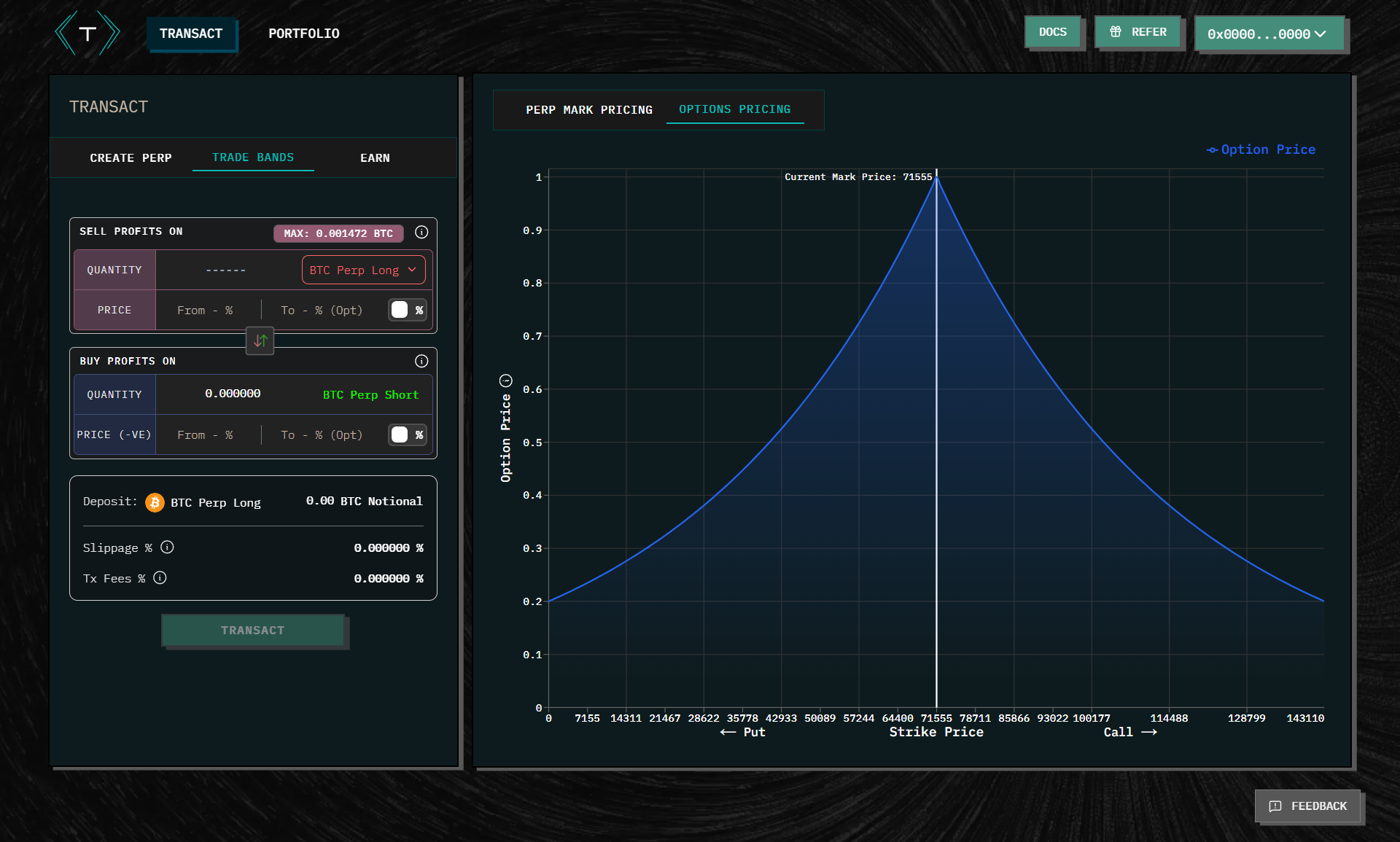
Band pricing is determined by the AMM.
The price of a band at any given strike is a function of the reserves available at that strike:
$$
\mathbf{P\_s = F(R\_s)}
$$
* **s** is strike expressed in relative (%) terms vs. perp mark price at entry, not absolute dollar terms, e.g., a call option with a strike at +25% means the strike is set 25% above the prevailing perp mark price when the position is opened.
* **P****s** is the price at strike s, expressed as a fraction of the perp, e.g. a call with a strike of +30% from the entry perp mark price might be priced at 0.6 — meaning its value is 60% of the whole long perp, because it captures only a ‘slice’ of the perp’s total payout.
* **R****s** is the reserves available at that strike
* **F** is the AMM’s pricing function.
**Price impact of trades:** trades at strike ‘s’ affects the reserves — and therefore the pricing — at strikes further out of the money than ‘s’.